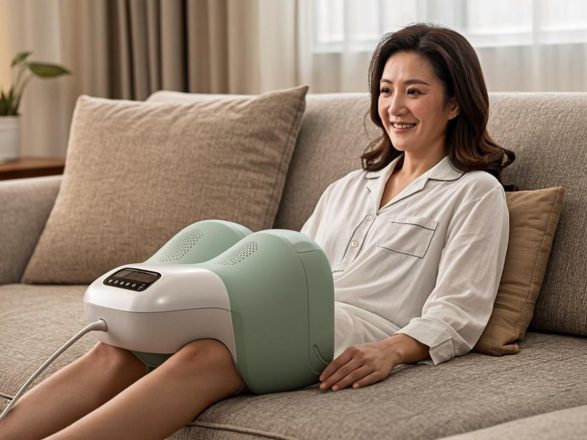
If your legs feel heavy, tight, or restless by evening, an air-compression leg massager is one of the simplest comfort tools you can own: it wraps the calf and foot in soft chambers that rhythmically inflate and deflate, mimicking the “second heart” squeeze your calf muscles give your circulation when you walk — and a regular 20-minute evening session is the routine most people report easing that heavy-leg feeling over the first two weeks.
This guide covers the whole subject the honest way: what the device actually does (and doesn’t), who tends to benefit, how it compares with vibration wraps and compression boots, a concrete evening routine, safety limits, and a five-point buying checklist. Everything here is comfort-focused — we sell two comfort devices ourselves, and we would rather earn your trust than oversell a gadget.
Why Legs Get Heavy: The “Second Heart” in Plain Words
Your calf muscles are sometimes called the body’s “second heart,” and the nickname is earned. Every time you walk, the calf muscles squeeze the deep veins in your legs and push blood back up toward your chest — a pump that works only when the muscles around it work. Sit for six hours, stand in one spot for a shift, or take a long flight, and that pump barely runs. Fluid quietly settles into the lower legs, and by evening the legs feel heavy, snug at the ankles, and restless on the sofa.
We go deeper into this mechanism — and what else supports it — in our leg circulation support guide. The short version: movement is king, elevation is queen, and an air-compression massage is the servant that does the squeeze for you when the day didn’t let you move enough.
What an Air-Compression Leg Massager Actually Does
Inside a leg massager like our LegEase, the wrap is divided into soft air chambers around the foot, ankle, and calf. A small pump fills them in a gentle sequence — lower chamber first, then upward — holds the squeeze for a few seconds, and releases. One full cycle takes under a minute, and a session runs several cycles at a pressure you choose.
What that rhythm feels like: a slow, traveling hug that tightens from the ankle upward and lets go. Most people settle into it within two or three cycles — it is the same principal as the compression boots athletes use after training, scaled for the living-room chair instead of the training room. The sensation is comfort, not medical treatment, and honest brands print that distinction where you can see it.
Who Tends to Benefit Most
Four groups of people tell us the same story about heavy legs, and air compression speaks to all four:
- People who stand all day — nurses, retail staff, teachers, hairdressers. Their calf pump runs on tiny, exhausted movements instead of real strides, and the evening squeeze feels like finally exhaling.
- Readers of the 45+ club. From the mid-forties on, circulation simply gets less spry. A daily seated session fits the same slot as the evening news.
- Long-haul travelers and desk sitters. Flights and spreadsheets both freeze the calf pump for hours; the session afterward doubles as a wind-down.
- Active walkers and gardeners. Not because their circulation needs help, but because a post-activity squeeze is a pleasant ritual that marks “the day is done.”
One group deserves its own honest paragraph: anyone with diagnosed circulation disease, diabetes with nerve involvement, a history of blood clots, or pregnancy should clear any compression device with their doctor first. Compression is a real physical force, and some conditions make it the wrong force. That conversation is medicine’s job — our job is to be worth recommending after the green light.
Air Compression vs. Vibration Wrap vs. Compression Boots
| Air compression (LegEase class) | Vibration wrap | Boot-style systems | |
|---|---|---|---|
| Feel | Traveling squeeze up the leg | Buzz over the contact patch | Stronger, chambered squeeze |
| Covers | Foot, ankle, calf in one wrap | Small area it touches | Full leg, arm-length sleeves |
| Best for | Heavy-leg evenings, the second-heart ritual | Spot relaxation on one muscle | Athletes, recovery rooms, bigger budgets |
| Reality check | Comfort device, not therapy | Comfort device, not therapy | Comfort device — with a pro price tag |
| Typical spend | Mid-range | Lowest | Highest |
If your goal is the evening heavy-leg ritual, air compression is the category built for exactly that. If you want to spot-massage a knotty calf muscle, a simple vibration wrap is cheaper and fine. If you are an athlete who lives in a recovery room, boots justify themselves.
A Simple 20-Minute Evening Routine
- Minute 0–2 — Settle in. Sit with legs roughly level, wrap seated so the heel sits in the heel pocket. Snug, not tight — you should slide two fingers under the strap.
- Minute 2–18 — The session. Start at low pressure for the first cycle or two, then step up to a firm-but-pleasant squeeze. Read, watch your show, do nothing — the chambers do the work.
- Minute 18–20 — Release and walk. Unwrap, stand, take a slow lap of the house. Legs feel lighter precisely because you gave the pump its evening shift.
- Optional close — Warmth for the knees. Many LegEase owners follow with gentle heat on the knees, our evening knee ritual style, since the session already has them seated.
Five evenings a week for two weeks is the honest trial window. The ritual matters more than the device on any single night — routines, not sessions, are what people feel by week three.
Honest Limits: What a Leg Massager Will Not Do
It will not treat vein disease, dissolve clots, cure anything, or replace movement — the second heart still needs your walks. It will not fix swelling that is new, one-sided, or comes with pain or redness; sudden unexplained swelling belongs with a doctor, quickly. And it will not feel wonderful to everyone: a minority find any squeeze unpleasant, which is exactly why a written 30-day guarantee matters. Ours is on the guarantee page, alongside the 1-year warranty.
How to Choose One: The 5-Point Checklist
- Chambers that sequence upward — one chamber squeezing everywhere is a balloon; three or more chambers traveling up the leg is the real second-heart rhythm.
- Adjustable pressure with a low first setting. First sessions should start gentle; a device with only one firm setting loses half its household.
- Foot and ankle coverage. Heavy-leg feeling starts at the ankle; wraps that skip the foot skip the feeling.
- Corded reliability or long battery, clearly stated. A 20-minute ritual dies if the battery dies on day three — check the honest spec sheet.
- A company that publishes limits. If a listing never mentions who should not use it, the brand is selling to you, not advising you. Ours does — start at the LegEase overview page or the product page itself, the LegEase air compression leg massager.
Frequently Asked Questions
Is a leg massager good for circulation?
As a comfort ritual, yes — the rhythmic squeeze supports the same calf-pump mechanism walking does, which is why heavy, tired evening legs are the complaint it suits best. It is a comfort device, not a treatment for circulation disease; diagnosed conditions need a doctor’s guidance first.
How often should you use a leg massager?
Most people settle on 4–6 sessions a week of 15–30 minutes, usually in the evening. Daily use is common among people who stand all day; if the skin stays comfortable and there is no unusual soreness, the routine is working for you.
Can you use a leg massager every day?
Healthy adults generally can, and gentle daily rhythm is the pattern that builds the habit. Skip sessions on irritated skin, and treat numbness, tingling that outlasts the session, or new one-sided swelling as stop-signals for a doctor visit, not for “pushing through.”
Does vibration help circulation?
Vibration relaxes the muscles it touches, and relaxed muscles are pleasant — but it does not provide the traveling squeeze that mimics the calf pump. That is why heavy-leg evenings respond better to air compression, while vibration is a fine spot-relaxation tool.
Leg massager or compression socks?
Socks are all-day passive pressure — great for travel days and long shifts. A massager is an active evening ritual with a stronger, cycling squeeze and then it comes off. They are complements, not rivals; many frequent travelers own both.
What is the best time to use a leg massager?
The hour when your legs have filed their complaints: evening, seated, ideally attached to something you already do (your show, your reading). Morning sessions suit people whose legs feel heavy on waking; consistency matters more than the clock.
Can pregnant women use leg compression massagers?
Not without a doctor’s approval — pregnancy changes circulation in ways that make compression a medical question, not a comfort purchase. Ask the obstetrician first; leg elevation and walking are the usual pregnancy-safe tools meanwhile.
Are leg massagers safe for diabetics?
Only with a doctor’s guidance, particularly with any nerve involvement in the feet. Reduced sensation means you may not feel a squeeze that is too strong, so professional clearance is the required first step — then the device can be judged like anyone else’s.
How long should each session be?
15–30 minutes is the sweet spot for most people. Longer is not better; the squeeze is a rhythm, not a marathon, and the evening lap of the house afterward is part of the routine.
Do leg massagers help heavy, restless legs at night?
Heavy-leg evenings are the scenario this category fits best — the squeeze settles what standing days stirred up. Restless sensations that persist regardless of comfort routines deserve a doctor conversation; comfort devices are for comfort, and honest stores say so.